

The Proud Ones (1956), directed by Robert Webb (Beneath the 12-Mile Reef, Love Me Tender, White Feather), featured Robert Ryan as Cass Silver, a by-the-book, older marshal who takes a younger man (Jeffrey Hunter) under his wing as a deputy. The younger man, who was a boy when his father was shot, nurses a distrust of Ryan due to the fact that it was the marshal who had shot his father, who was described bluntly by Ryan as a "no-good gun slinger." Despite his apparent black and white way of looking at the world, Ryan is haunted by this act of perceived cowardice from his distant past. Living what he believes is a settled, well-ordered life, his precise manner, which includes such touches as carefully keeping the books as he doles out his deputy's pay and accepting the limitations of his personnel and the citizenry, Ryan brings his brooding presence to the role of a man who seems to carry a psychological weight through his placid, prosaic existence.
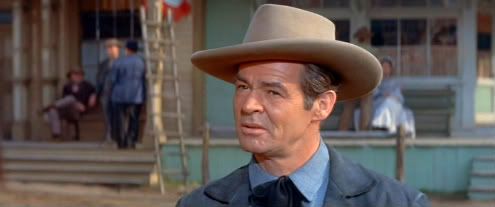 Robert Ryan in The Proud Ones (1956)
Things have changed in Ryan's relatively peaceful one horse town in Kansas. The burg has been transformed from a backwater to a boom town after the railroad and the subsequent cattle drives arrive. Along with the prosperity that accompanies this progress comes Robert Middleton, the '50s favorite rotund villain (next to Burl Ives) as Honest John Barrett, a man who runs a crooked traveling gambling establishment that comes complete with hired guns, including Rodolfo Acosta, and a man with a scar (Ken Clark).
Ryan is leery of all these men, in part because of an earlier run-in in the past that had sullied the marshal's reputation for fair play, driving him to move away to this new town after Barrett spread a persuasive rumor that Silver gunned down Hunter's father in cold blood. Even Ryan finds himself questioning his own actions and trying to explain his motivations to himself and others, which is an uncomfortable position for a Westerner who is normally a card-carrying member of that big frontier club belonging to strong, silent types.
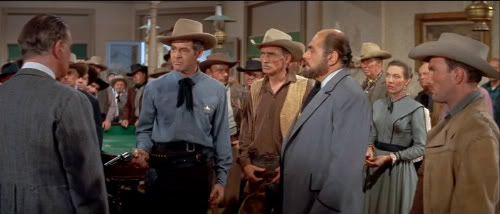 Robert Ryan and Robert Middleton in a scene from The Proud Ones (1956)
Soon he has more reason to be worried. Things get increasingly dicey after Ryan gets a mean thump to the head while doling out some law and order. There is a realistic vein running through this movie, and the consequences of that encounter leaves the marshal with increasing episodes of blurred vision, (a nice metaphor of his world view too). Reaching down to the floor quickly to retrieve a badge that has been dropped in his office, Ryan finds his vision blurred further, and seems to have problems with his equilibrium as well. On top of that, Ryan's current deputies are not men who can be relied upon to take up the slack in town. They are played by a subdued Walter Brennan and nervous, expectant father Arthur O'Connell, neither of whom are much help at the best of times. (The only thing that would be worse is if Chubby Johnson were a deputy, something that seemed to happen to Randolph Scott in more than one movie.)
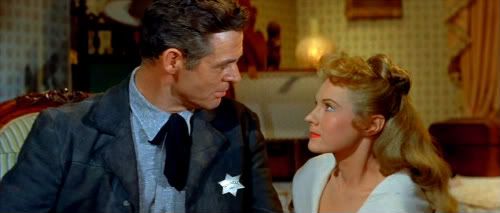 Robert Ryan and Virginia Mayo in The Proud Ones (1956)
Not only that, but the pantywaist Chamber of Commerce types, Richard Deacon and Whit Bissell, are among the wishy-washy townsfolk who employ Ryan. (I figure that the tag team of Deacon and Bissell squeezed in their tacked-on, up tempo appearance at the end of Invasion of the Body Snatchers around the same time as this movie's production). Since guys like Deacon and Bissell are doing very nicely since the arrival of the newcomers in town, none of them are willing to put it all on the line for law and order in the town--not while there is a buck to be made. Ryan soon finds out that even the local doctor (Ed Platt, in his perennial worrier mode) is not to be trusted. Consulting Doc about his wee bit of blindness, he asks and is assured that the physician is ethical enough to keep the marshal's problems to himself.
That little illusion is history once Ryan's medical issue is immediately divulged to Virginia Mayo by Platt, who must have forgotten that clause in the Hippocratic Oath about clamming up. In her brief scenes, Mayo overplays terribly as the marshal's dance hall veteran and concerned fiancee, squawking at him about blowing town--pronto.
I suspect that the actress was determined to make something out a role that is a walking cliché, with little help from the script or the director. While Mayo was extremely effective in a few western roles, particularly opposite Joel McCrea in director Raoul Walsh's remake of High Sierra, called Colorado Territory (1949), I suspect that she needed a strong director to guide her. Actually, I tend to think that Mayo's best dramatic performances were all under the tutelage of Mr. Walsh. In many of her other roles she overdoes the sultry wildcat bit, but with Walsh she comes across better on screen, whether amusingly vulgar and duplicitous, as in White Heat (1949) or lady-like, warm and human, as she appeared in Captain Horatio Hornblower R.N. (1951).
 Jeffrey Hunter in The Proud Ones (1956)
Well, you probably know the outcome of all this plot, which is part High Noon, part Lord Jim, part Rio Bravo, part The Tin Star. A couple of things make this movie interesting to me: Ryan's marshal is a man with a latent conscience whose frailty makes him re-examine his life--though he feels obliged to fulfill his duty, even after the town fathers ask for his resignation. His relationship with the youthful Hunter is interesting as the boy goes from skepticism to alliance--but his faith in the older man wavers seriously from time to time, creating considerable suspense. Hunter can't decide if he wants to become a gunslinger or a lawman, but his ultimate choice is handled rather well, in this straight-forward, color film photographed in Cinemascope by Lucien Ballard. The fact that by the conclusion Ryan finds himself dependent on another person for forgiveness and redemption also teaches his character a valuable lesson in humility. That's an unusual lesson for a Western in the '50s, made more interesting by Ryan and Hunter's uneasy relationship, which is not quite developed as far as it might be, though the two actors raise the story above the B western category that 20th Century Fox seems to have intended this movie for in that decade.

It's not a great movie, but was made more compelling, as usual, by the presence of Robert Ryan. Robert Middleton and Jeffrey Hunter do a good job in the supporting cast, as do everyone except perhaps the misguided Virginia Mayo.
I think that 20th Century Fox meant it for the B movie market. Btw, I forgot to mention that the theme is by Nelson Riddle, whose whistling tune pre-dated Ennio Morricone's more famous scores for spaghetti westerns. You can hear the whistler on this video below. The whistling performer is either Muzzy Marcellino or Fred Lowery. The accomplished Marcellino also contributed to The Good, the Bad, and the Ugly a decade later.
The Proud Ones (1956), which is about 98 brisk minutes long, is available on DVD and can be seen on the Encore Western Channel from time to time. The next time it is scheduled for broadcast is Sunday, September 19th at 5AM ET, Sunday, November 7th at 6:15AM ET, Thursday, November 11th at 2:50PM ET.


0 Yorumlar